

Composite bonding has become the fastest-growing cosmetic request among international patients in Turkey, and the reasons are practical rather than fashionable. In most cases nothing is drilled away. There is no laboratory wait. The result is finished and visible before you leave the chair. And the cost sits well below ceramic veneers — far enough below that patients who could never justify UK private rates for cosmetic work find bonding within reach. For anyone wanting a better-looking smile without signing up to something irreversible, it is the sensible place to start.
What Composite Bonding Involves
Bonding is tooth-coloured composite resin applied directly to the tooth, shaped by hand into the form the dentist and patient have agreed, then hardened with a UV curing light. The distinction from porcelain veneers is fundamental rather than incremental: a veneer is manufactured in a laboratory and bonded to a tooth that has been reduced to make room for it, whereas bonding is additive — in most cases nothing is taken away. That makes it reversible. If a patient later decides they want ceramic, the composite comes off and the tooth underneath is as it was. What you gain is a smoother, more even, better-shaped tooth. What you give up is longevity: composite picks up stain over the years and stands up less well to heavy bite forces than ceramic does.
Composite Bonding vs Porcelain and E-max Veneers
| Factor | Composite Bonding | Porcelain Veneer | E-max Veneer |
| Tooth preparation | None in most cases | Minimal enamel reduction | Minimal enamel reduction |
| Reversibility | Reversible | Permanent commitment | Permanent commitment |
| Treatment sessions | 1 (same day) | 2 (includes lab stage) | 2 (includes lab stage) |
| Laboratory required | No | Yes | Yes |
| Stain resistance | Moderate | High | High |
| Durability | 5–7 years | 10–15+ years | 10–15+ years |
| Cost per tooth (Turkey) | £120 – £150 | £160 – £300 | £250 – £400 |
When Bonding Is the Right Call
- Chipped or slightly fractured front teeth needing an immediate cosmetic fix
- Small gaps between teeth that can be closed without orthodontics
- Teeth of irregular shape or slightly uneven length that pull attention from an otherwise healthy smile
- Discolouration that has not responded to professional whitening
- Patients who want a visible improvement now but are not ready for a permanent ceramic commitment
- Younger patients whose teeth are not yet suitable for irreversible veneer preparation
- Anyone working to a tighter budget who wants to improve their smile while saving toward ceramic
2026 Composite Bonding Price Comparison
| Country / Region | Average Cost | Notes |
| UK (per tooth, private) | £200 – £600 | Not available on NHS for cosmetic purposes; London above this range |
| Germany (per tooth) | €150 – €500 | Private only; not covered by statutory insurance |
| Turkey (Dental Harmony Turkey) | £120 – £150 | Per tooth; same-day result; no laboratory wait |
Six teeth is a common treatment scope, so it makes a useful comparison. At UK private rates that comes to £1,200–3,600. The same six teeth at Dental Harmony Turkey cost £720–900 — and that is before accounting for the efficiency of handling it alongside other dental work in the same trip.
The Procedure, Step by Step
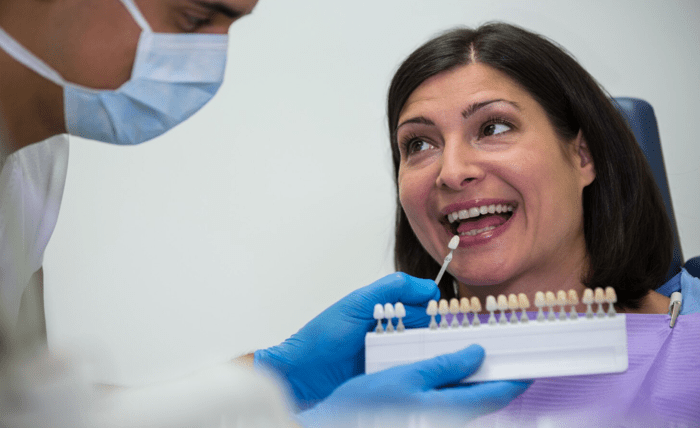
- Shade matching — The composite shade closest to the surrounding natural teeth is chosen from a shade guide before anything else happens.
- Surface preparation — The enamel is lightly etched with a conditioning gel to give the resin something to grip. No anaesthetic is normally needed, since no tooth structure is being removed.
- Bonding agent application — A thin adhesive primer is painted onto the etched surface and cured with UV light.
- Composite application — Resin is applied in layers and sculpted by hand, with the shape built up incrementally rather than in one mass.
- Curing — Each layer is hardened under the curing light before the next goes on, building strength as the form develops.
- Finishing — The tooth is trimmed, contoured and polished to the finished result, which is visible in the same appointment.
Allow roughly 30–60 minutes per tooth. A six-tooth case is usually completed comfortably within a single half-day appointment.
Making It Last
Realistically, bonding gives 5–7 years before it needs touching up or replacing — with the length depending largely on habits. Not biting nails or chewing pens, going easy on heavily pigmented drinks, and having the bonding polished at routine appointments all extend it. That last one is worth taking seriously: annual polishing at a local dentist lifts surface staining before it works its way into the material, and patients who do it consistently get noticeably more life out of their bonding. Anyone with a heavy bite or bruxism should not have bonding placed without a protective night guard.
Moving Up to Ceramic Later
A common and entirely sensible pathway is to start with bonding and upgrade to ceramic veneers or crowns later, when budget allows or when the composite reaches the end of its life. Dental Harmony Turkey offers both and will advise at consultation on which suits each individual tooth — the answer is often not the same across every tooth in a smile. For patients ready to make that move, the E-max crowns in Antalya page sets out the material, the clinical process, and pricing for both single-tooth and multi-unit E-max work.
Final Thoughts
Composite bonding in Turkey in 2026 is a practical, genuinely affordable option for patients who want a visible improvement without permanence or a large upfront outlay. Dental Harmony Turkey, an established Dental Implant Clinic Antalya with a full cosmetic offering, treats bonding as one component of a broader smile design service that can bring together veneers, crowns, whitening and implants inside a single coordinated visit to Antalya.